Software Architecture
The fd.io vpp implementation is a third-generation vector packet processing implementation specifically related to US Patent 7,961,636, as well as earlier work. Note that the Apache-2 license specifically grants non-exclusive patent licenses; we mention this patent as a point of historical interest.
For performance, the vpp dataplane consists of a directed graph of forwarding nodes which process multiple packets per invocation. This schema enables a variety of micro-processor optimizations: pipelining and prefetching to cover dependent read latency, inherent I-cache phase behavior, vector instructions. Aside from hardware input and hardware output nodes, the entire forwarding graph is portable code.
Depending on the scenario at hand, we often spin up multiple worker threads which process ingress-hashes packets from multiple queues using identical forwarding graph replicas.
VPP Layers - Implementation Taxonomy
The vpp dataplane consists of four distinct layers:
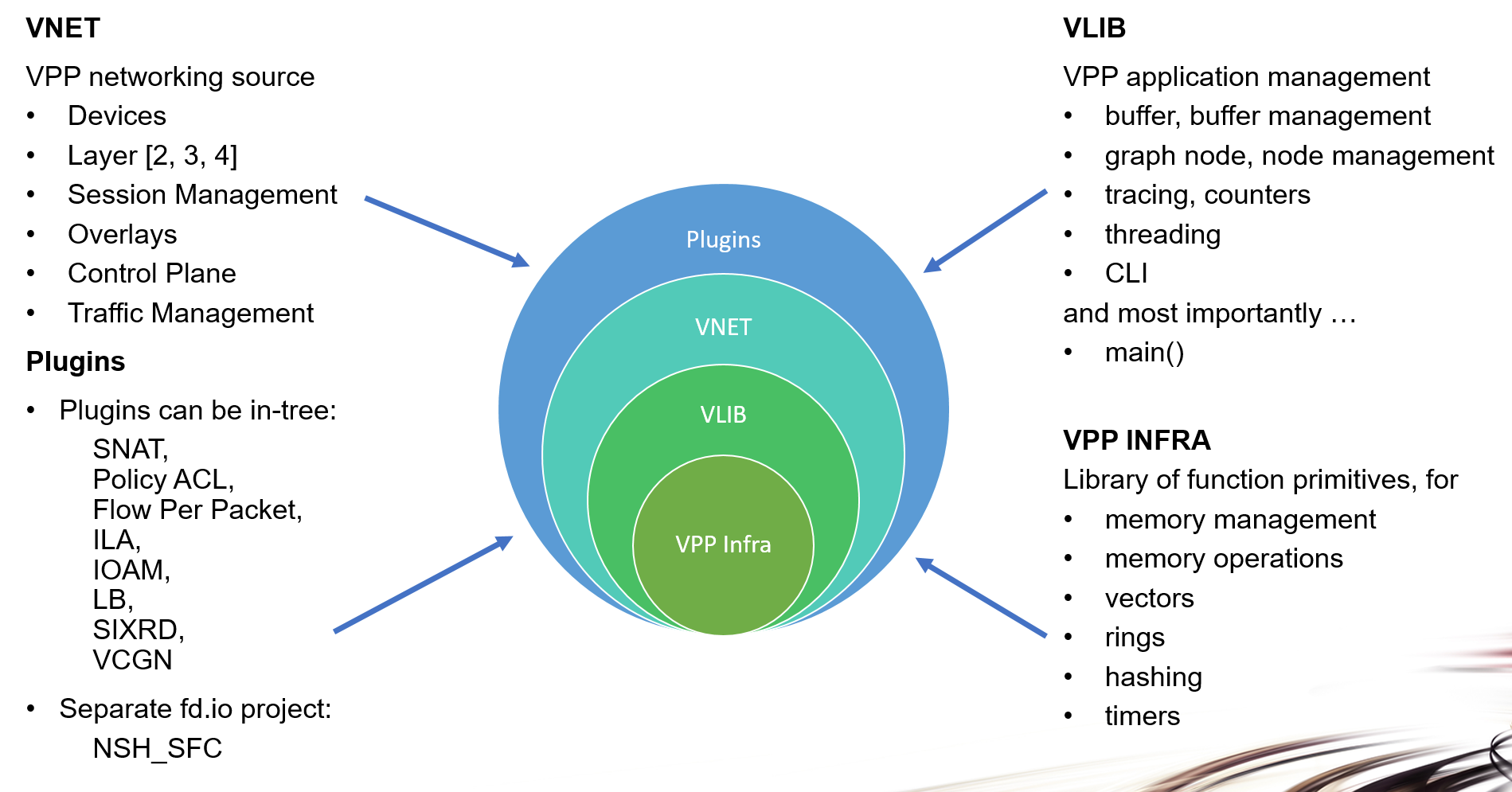
- VPP Infra - Is the VPP infrastructure layer, which contains the core library source code. This layer performs memory functions, works with vectors and rings, performs key lookups in hash tables, and works with timers for dispatching graph nodes.
- VLIB - performs various application management functions, such as managing buffers and graph nodes, working with counters an threading, performs tracing, and works with the CLI (command line interface).
- VNET - works with VPP’s networking interface (layers 2, 3, and 4) performs session and traffic management, and works with devices and the data control plane.
- Plugins - Contains an increasingly rich set of data-plane plugins, as noted in the above diagram.
It’s important to understand each of these layers in a certain amount of detail. Much of the implementation is best dealt with at the API level, and otherwise left alone.